
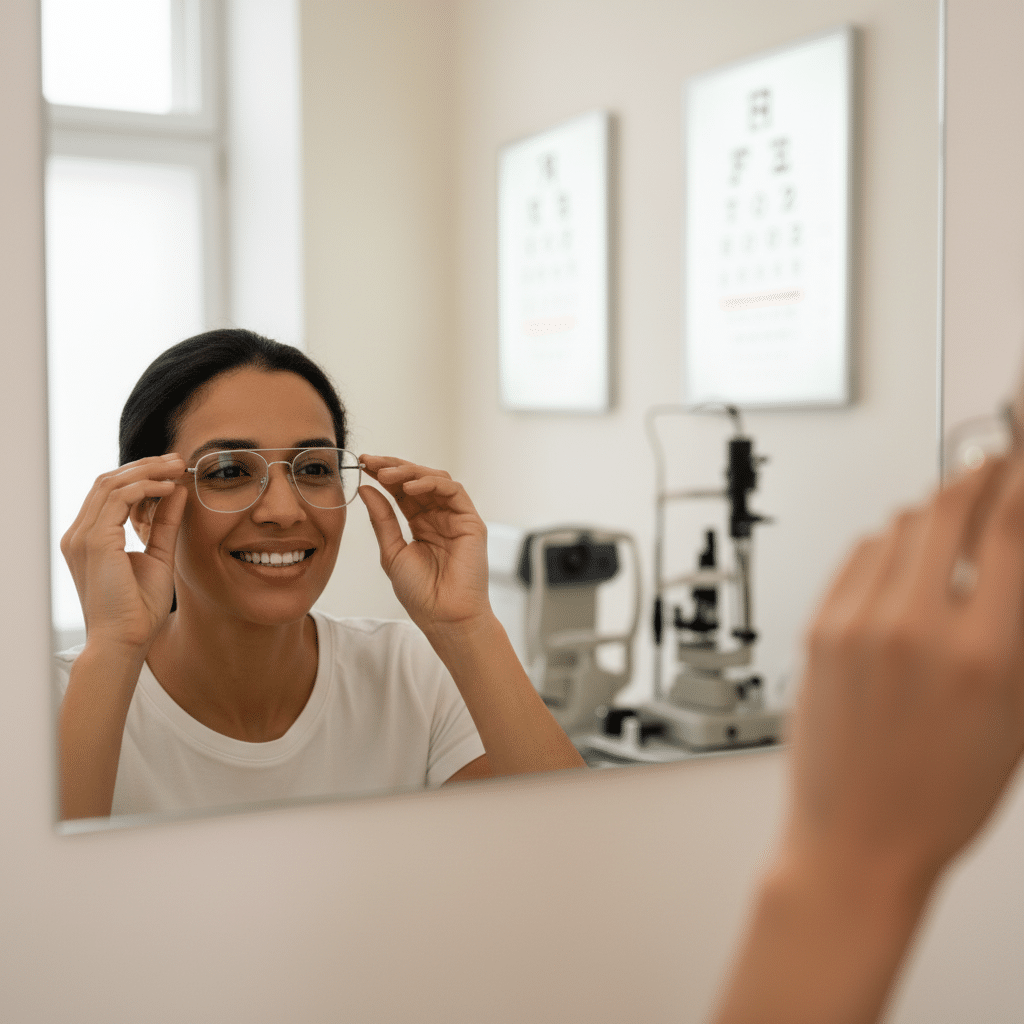
Buying prescription glasses should be one of the more enjoyable things you do for yourself, and yet most people go into it feeling slightly out of their depth. This guide explains what you are actually paying for, what separates a good pair from a mediocre one, and what to ask before you commit. It is written from what we see week to week at our practice in Belsize Park, including the pairs that come back to us because something was not quite right the first time.
What you are actually buying
You are buying three things that happen to arrive as one object: a lens made to your prescription, a frame to hold it, and the measurements and fitting that put the two together correctly on your face.
Almost all the attention goes on the frame, because it is the part you can see and the part you fall for. It is also the least technical of the three. The lens does the optical work, and the measurements decide whether that work lands where your eyes actually are. Get those wrong and even an excellent lens in a beautiful frame will feel slightly off, without you ever being able to say why.
| A GOOD PLACE TO STARTIf you want to see how the whole process fits together before you go anywhere, our prescription glasses page sets out the lens options and what happens at each stage. No appointment needed to have a read. |
The four things that decide whether a pair of glasses is any good
An accurate, current prescription. The right lens for how you use your eyes. Correct measurements. A proper fit, with someone to adjust it afterwards. Everything else is preference.
1. An accurate, current prescription
Everything is built on this. A prescription taken in a rushed twenty-minute test, or one that is two years old and no longer matches your eyes, quietly limits every pound you spend on top of it.
You are free to take your prescription anywhere and should never feel awkward about doing so. The College of Optometrists does note that prescribing and dispensing are closely linked, so it is usually simpler to have glasses made where your eyes were examined, if only because problems are easier to sort out. If your last eye examination felt hurried, fix that before you spend money on lenses.
If your prescription itself looks like code, our plain-English guide to reading your glasses prescription explains what each number means. If you wear contact lenses as well, the two prescriptions are not interchangeable, so both need keeping current.
RUPAL RECOMMENDS: If you wear contact lenses most days, do not let your glasses drift years out of date. Your eyes need a break from lenses, and the pair you reach for at ten at night should be one you can actually see through.
2. The right lens for the way you actually use your eyes
The lens is where most of the quality, and most of the cost, sits. Three things matter: the design, the material, and the coatings.
Design is whether the lens corrects one distance or several. Material decides how thin and light the lens can be, which matters more the stronger your prescription is. Coatings do the smaller jobs, cutting reflections from headlights and screens, or resisting scratches.
3. The measurements, which nobody talks about
This is the quiet one, and the reason two pairs made to the same prescription can feel completely different.
Your pupillary distance, the gap between the centres of your pupils, decides where the optical centre of each lens sits. It is not part of your prescription, because it is a dispensing measurement rather than a clinical one. Varifocals need further measurements again, because the reading zone has to sit exactly where your eyes drop to.
This is where ordering online most often comes unstuck, because you measure yourself. College of Optometrists-funded research found glasses bought online were twice as likely to fail optical tolerance tests as those supplied by high street practices, with incorrect self-measured pupillary distances a large part of the reason. The study was small and dates from 2016, and the College itself called for more data, so treat it as a caution rather than a verdict.
4. The fit, and what happens after you pay
Glasses are worn objects. They get sat on, pushed up by hair, and dropped into bags, and they drift out of alignment with ordinary use. A pair that fitted beautifully in March will not necessarily sit right in September.
So the question is not only whether the fit is good on collection day, but whether there is somewhere to take them when it is not. Every pair bought from us includes aftercare as standard, covering adjustments, a proper clean and minor repairs. You pop in during opening hours, and we sort it.
Why the frame and the lens have to be chosen together
Because the frame decides how thick, how heavy, and how optically comfortable your lens is allowed to be.
A large, deep frame gives a strong prescription room to grow thick at the edges. A smaller, rounder frame keeps the same prescription noticeably slimmer and lighter. Rimless designs need a tougher lens material, which narrows your options. Varifocals need enough depth for the reading zone to work, so the very shallow frames that are fashionable are often the wrong choice, however good they look.
This is why choosing a frame first and thinking about lenses later so often ends badly. It should be one conversation, not two. When you look at our frames, someone should be telling you what each one will do to your lens before you fall for it, not afterwards.
Independent practice, high street chain or online
All three can produce a perfectly good pair of glasses. What differs is how much time goes into the parts you cannot see, and how much of the work you are expected to do yourself.
Ordering online is cheapest and gives you the widest choice of frames. You take on the measuring, the judgement about whether a frame suits your prescription, and the problem of what to do if it arrives wrong. For a simple prescription and a spare pair, plenty of people are perfectly happy, and a fifth of participants in that College research said they would buy online again anyway, for the price and the lack of pressure. That is a fair trade to make with your eyes open.
A larger practice gives you convenience, longer opening hours, and someone in front of you to check the fit. Where the model shows is in the time available per person, and in how often you see the same face twice.
An independent practice is buying you time and continuity. You get a 45-minute eye examination rather than the twenty minutes that is standard elsewhere, and the same optometrist takes you from the first test through to the styling. You are not handed along a chain of people, and your history is already on file the next time something changes. That is why the practice has run the way it does since 2009.
The difference matters most with a complex or strong prescription, when you are moving into varifocals, or when you have simply never got on with glasses and nobody has worked out why.
What a proper fitting actually involves
Four stages: measuring and choosing, ordering, collecting, and adjusting. If a purchase skips straight from choosing to handing over a bag, something has been left out.
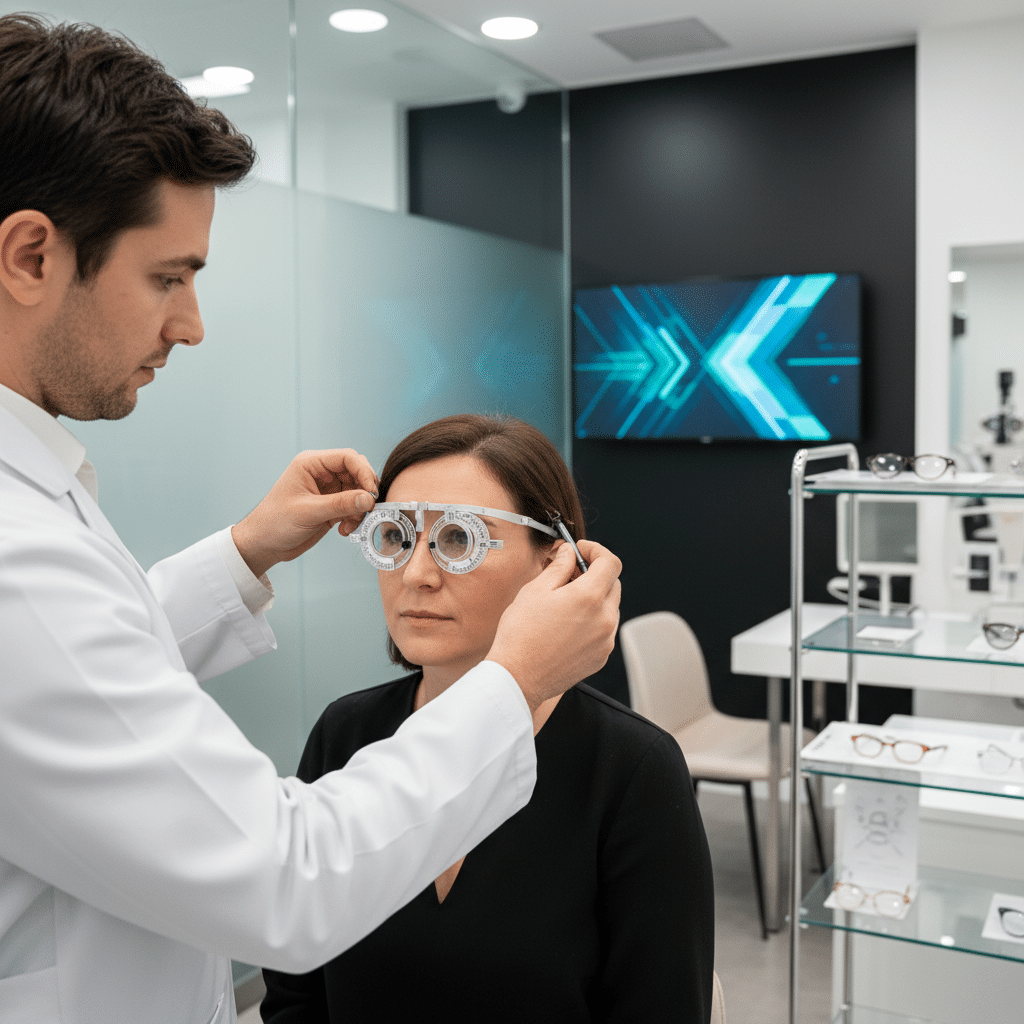
The College of Optometrists describes what to expect: a dispensing optician should look at your prescription, ask about your work and hobbies and take facial measurements, then help you choose frames and lenses that fit comfortably and suit how you live. When you collect, they check the fit and adjust anything that needs it.
In practice, expect someone to ask what you do all day before they ask what you like the look of. Whether you drive at night, how long you spend at a screen and at what distance, whether you read in bed. Those answers change the lens recommendation more than your prescription alone does.
RUPAL RECOMMENDS: Bring the two pairs you actually reach for, not the newest ones, and bring them even if they are scratched and bent. How a frame has worn and where it has slipped tells me more about how you use your eyes than the letter chart does on its own.
You should also expect an honest opinion on how a frame looks on you. That is part of the job, and the part most often skipped. For a sense of how that turns out, our happy client gallery is real people in the frames they went home with.
| READY TO GET IT RIGHT? This is the point where most people find it easier to just come in and talk it through. You can book an appointment online in a couple of minutes, or call us on 020 7586 5508. Bring your current glasses and your last prescription if you have it. |
What you should expect to spend
The lens usually drives the price more than the frame does, which surprises most people.
Four things move the figure. The lens design, because a varifocal involves far more work than a single vision lens. The material, because a thinner lens for a stronger prescription costs more. The coatings you add. And the frame, which can be modest or very much not.
So a pair of glasses can be very reasonable or a real investment, and the deciding factor is more often your eyes than your taste. Insist that the options and their costs are laid out clearly before you commit, with nothing appearing at the till that you did not expect. A modest frame with the right lens will serve you better than an expensive frame with the wrong one.
We keep our answers to cost questions in one place on our pricing and FAQ page, so you can see where you stand before you come in.
Seven questions worth asking before you buy
Ask these anywhere, including here. A practice comfortable answering them is usually one worth buying from.
- How old is my prescription, and would you recommend a fresh test before we order?
- Which lens design are you recommending for me, and what is the reason for that rather than the cheaper option?
- How thick will this lens be in this particular frame, and would a different frame improve that?
- What measurements are you taking, and are you taking them with this frame on my face?
- What is included in the price, and what is extra?
- What happens if I cannot get on with them, and how long do I have?
- Who do I come back to for adjustments, and is there a charge?
The last two matter more than people expect. Adjustments are not a one-off event; they are the rest of the life of the glasses.
RUPAL RECOMMENDS: Do not decide on the day you first try frames on. Narrow it to two, ask for a photograph of each, then go and have a coffee and look at them again. The pair people regret is nearly always the one they chose while feeling rushed.
Buying prescription glasses: your questions answered
Why is my pupillary distance not on my prescription?
Because it is a dispensing measurement rather than a clinical one, so it is not part of the legal prescription. Whoever makes your glasses should measure it, ideally with your chosen frame on your face. If you are ordering online, you will usually be asked to measure it yourself, which is where a lot of online orders go wrong.
Are expensive glasses actually better?
Not automatically. A higher price often reflects the frame brand rather than the optical quality of the lens. What genuinely improves the result is the right lens design for how you use your eyes, accurate measurements, and a proper fit. Those can be had at a range of prices.
Should I buy glasses online?
For a simple prescription and a spare pair, many people do so happily. Be aware that you are taking on the measurements yourself, and that the evidence suggests online pairs are more likely to fall outside optical tolerances. For varifocals or a strong prescription, having them fitted in person is the safer choice.
Buying glasses well is mostly about asking better questions
None of this is complicated once someone explains it, and none of it asks you to become an expert. An accurate prescription, a lens chosen for your life rather than a price list, measurements taken properly, and somewhere to go when they need adjusting. Get those four right, and you will be happy for years.
If you would like that done unhurriedly, by someone who sees you from start to finish, we would be glad to help. You can read how we approach prescription glasses first if you would rather look before you leap, or book an appointment online. Call 020 7586 5508 or find us at 8 England’s Lane in Belsize Park, a short walk from Belsize Park and Chalk Farm on the Northern Line. We will put the kettle on.
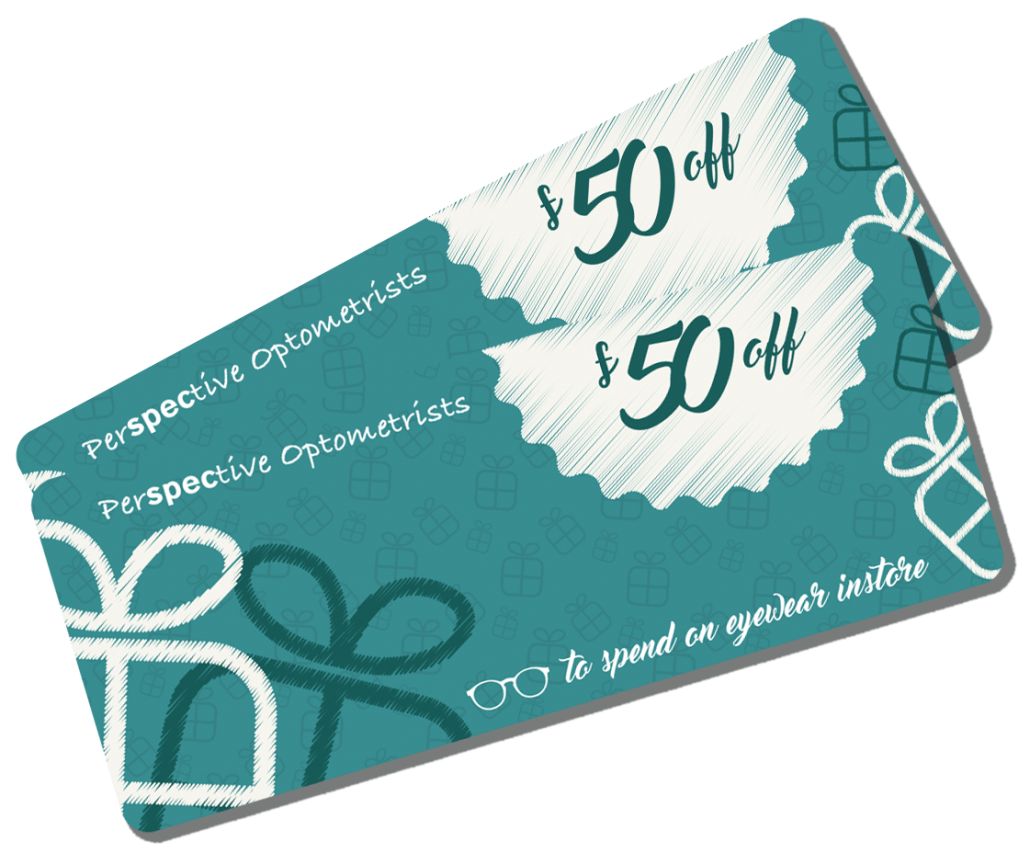
Not quite ready? Take a look at our £50 voucher towards glasses and keep it for when you are, or pop in for a browse with no obligation.