
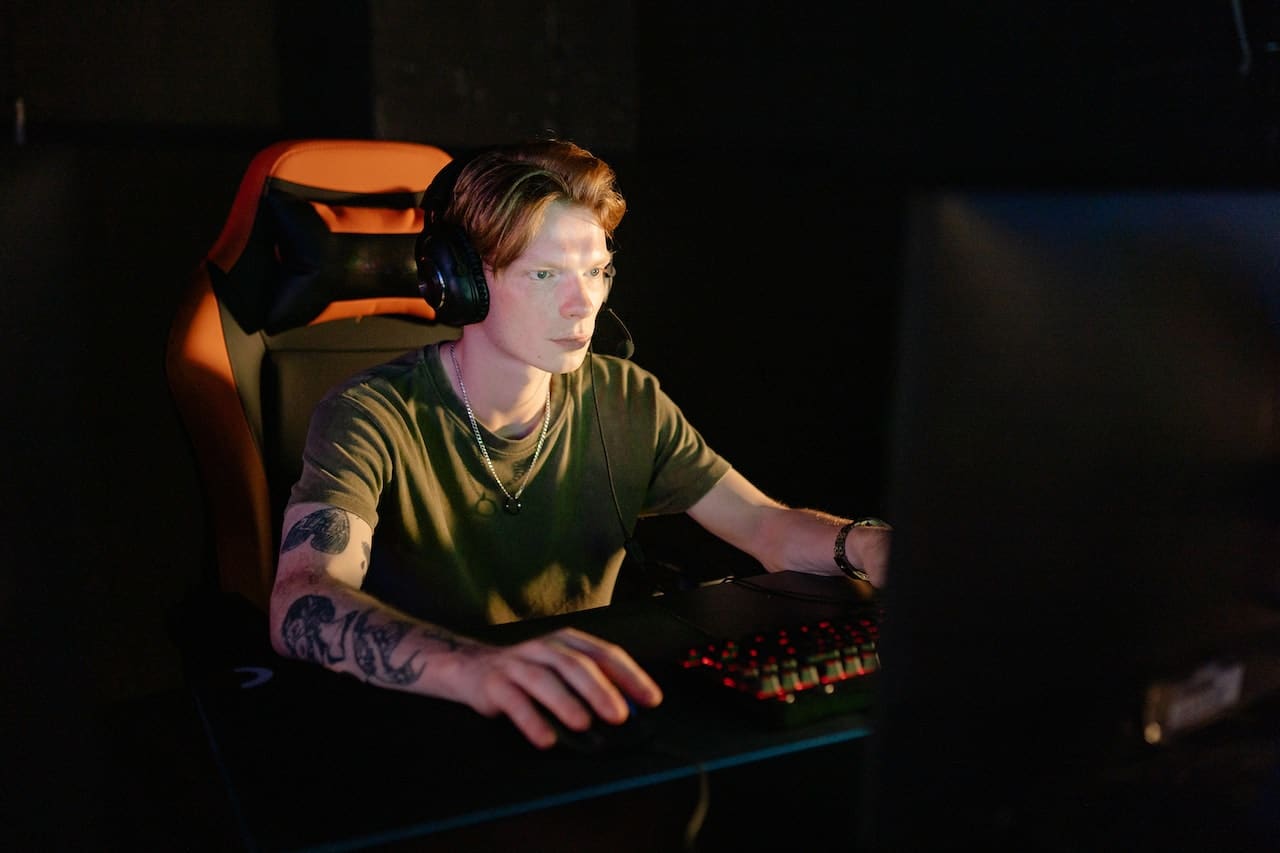
You are deep in a session, fully locked in, and then it creeps up on you: your eyes feel dry and heavy, the screen starts to swim a little, and there is a dull ache building behind your eyes. A long session should feel good from the first match to the last, so eye strain that pulls you out of the moment, and lingers as a headache after you log off, is worth doing something about.
The good news is that gaming eye strain is common, very manageable, and rarely a sign of anything serious. With a few small changes to how you set up and how you play, you can keep your eyes comfortable through far longer sessions. Here is what actually helps, whether you play on a monitor, a handheld or in VR, and when it is worth getting your eyes checked.
Gaming eye strain at a glance
| What tends to cause it | What helps most |
|---|---|
| Hours of screen time with no break | Short, regular breaks and the 20-20-20 rule |
| A screen too bright or too dim for the room | Matching your screen brightness to your surroundings |
| Blinking less while you concentrate | Conscious blinking and lubricating drops if needed |
| Glare and harsh lighting | Soft, indirect light and an anti-reflective lens coating |
| VR headsets and 3D depth | Shorter sessions, frequent breaks, and a check if it persists |
| An out-of-date or uncorrected prescription | A thorough eye examination |
| If your eyes feel tired or strained more often than they used to, the quickest way to understand why is a thorough eye examination. Book a comprehensive eye test at our Belsize Park practice. |
Why do your eyes feel it after a long session?
Gaming asks a lot of your eyes. You hold your focus at one fixed distance for hours, your eyes make constant tiny adjustments to track movement, and you tend to blink far less than usual. Optometrists call the result digital eye strain, or computer vision syndrome. It is the same family of symptoms many people get from long stints at a computer, and gamers often feel it more simply because sessions run long and the action keeps you locked in.
None of this damages healthy eyes permanently. But it is uncomfortable, and it can quietly mask an underlying issue such as an out-of-date prescription, so it is worth taking seriously.
Take regular breaks
The single most effective habit is also the simplest. Step away from the screen for a few minutes every hour, look around the room, and let your eyes refocus on something further away.
A handy version to remember mid-session is the 20-20-20 rule, recommended by the College of Optometrists. Every 20 minutes, look at something around 20 feet away for about 20 seconds. It gives the focusing muscles in your eyes a brief rest and resets that locked-in feeling before it builds.
If you lose track of time when you are in the zone, set a gentle timer or use a break reminder. Rested eyes tend to keep your reaction times sharper too, so it is not only the kinder choice.
Set up your screen properly
A few quick adjustments make a real difference.
Brightness. Match your screen to the light in the room. If the screen looks like a glowing light source, it is too bright. If it looks dull and grey, it is too dim.
Distance and position. Sit roughly an arm’s length from your monitor, with the top of the screen at or just below eye level. That keeps your gaze slightly downward, which is more comfortable and helps your eyes stay moist.
Glare. Angle the screen away from windows and bright lights to cut reflections. A matte display, or an anti-reflective coating on your glasses, helps here too.
Get the lighting right
Playing in a pitch-black room with a bright screen forces your eyes to work hard against the contrast, while harsh overhead light or direct sunlight on the screen causes glare. Aim for soft, indirect lighting that fills the room evenly, so there is less of a jump between your screen and everything around it.
Blink more often
When you concentrate on a screen, your blink rate drops without you noticing, and that is one of the main reasons your eyes feel dry and gritty after a session. Make a conscious effort to blink fully now and then, especially during loading screens or quieter moments. If your eyes still feel dry, lubricating eye drops can help.
This matters even more if you wear contact lenses, as long screen sessions can make dryness more noticeable. If that sounds familiar, mention it at your next appointment, as a different lens or wearing pattern may suit screen-heavy days better.
What about blue light and night mode?
This one is worth being straight about. Blue light from screens often gets blamed for tired eyes, and you will see plenty of products promising to block it. But the best current evidence, including a large 2023 review and the position of the College of Optometrists, does not support blue-light-filtering lenses as a way to reduce eye strain. The discomfort you feel is far more likely to come from how you are using the screen, the things covered above, than from blue light itself.
Where blue light does play a part is in sleep. Bright screens in the evening can make it harder to wind down, so a warmer night mode in the hours before bed is a sensible habit if you game late. Think of it as helping you sleep, rather than a fix for sore eyes.
So if a shop or website tells you blue light glasses will cure your gaming eye strain, treat that claim with healthy scepticism. We would always rather give you advice that genuinely works.
Playing in VR? Your eyes face an extra challenge
If you game in virtual reality, you are asking something of your eyes that a flat screen never does. A VR headset sits just inches from your face, yet the worlds it shows you stretch off into the distance. Your eyes try to focus as though objects are far away while the actual display stays fixed up close, and that mismatch, which optometrists call vergence-accommodation conflict, is the main reason VR can leave you with eye strain, headaches or a touch of dizziness. Some people start to feel it within twenty minutes.
It is usually temporary and settles once the headset comes off. To stay comfortable, build in more frequent breaks than you would on a monitor, take a moment to adjust the headset so the lenses sit squarely in front of your eyes and the image is as sharp as it can be, and stop sooner rather than later if discomfort creeps in. If VR consistently leaves you with sore eyes, headaches or nausea, it is worth getting your eyes checked, as an undetected focusing or eye-alignment issue can make the conflict harder for your eyes to handle.
Handheld and mobile gaming
Phones, the Switch and handheld PCs pull the screen much closer than a monitor, and the smaller the text and detail, the harder your eyes work to hold focus. The same habits apply, just more so. Hold the device a little further away than feels natural, keep the brightness sensible for the room, and take regular breaks. All that close-up focus also feeds into the wider picture around short-sightedness, which matters most for younger players.
Gaming and children’s eyes
Plenty of gamers are children and teenagers, and their eyes are still developing, so a couple of things are worth knowing. Children often will not mention that their eyes feel tired or that the screen looks blurry, because they assume that is simply how it is, so it helps to ask them directly.
On top of that, lots of close-up focus paired with less time outdoors is linked to rising rates of short-sightedness in children, and gaming is part of that picture for many families. This is not a reason to ban gaming. It is a reason to keep a gentle eye on it: encourage breaks and time outside, and book a children’s eye examination if your child squints, sits very close to the screen, complains of headaches, or simply has not been tested in a while. If short-sightedness is progressing, there are myopia management options designed to slow it down, and we are always happy to talk you through them.
When glasses or lenses make a difference
The right eyewear will not magically remove strain, but it can make long sessions noticeably more comfortable, especially if you already wear a prescription.
An anti-reflective lens coating cuts glare and reflections from your screen and the lights around it. If you spend most of your day at a screen, lenses tuned for that middle, screen-length distance can ease the constant refocusing. And if your prescription glasses are out of date, simply getting them right again often solves more than any gadget.
The only way to know what suits you is to have your eyes properly assessed and your needs talked through, which is exactly the kind of unhurried appointment we are known for.
| Not sure whether your glasses or lenses are pulling their weight for screen time? Book a lens and styling consultation, and we will help you find a setup that works for the way you actually play. |
When is it worth seeing an optometrist?
Occasional tired eyes after a marathon session are normal. It is worth booking an eye examination if you notice any of the following keep coming back:
- Eye strain, headaches or blurred vision that return regularly
- Eyes that feel dry, sore or gritty most days
- Needing to sit closer to the screen than you used to
- Double vision, or trouble shifting focus between near and far
| Often, the hidden cause is a small, uncorrected change in your prescription that your eyes are working hard to compensate for. A thorough eye test will pick that up, check the health of your eyes, and rule out anything that needs attention. If something does need specialist input, we can refer you to leading ophthalmologists through our established referral pathway. |
Want to go deeper on screens in general? Our guide to digital eye strain, its symptoms and how to prevent it, covers everyday screen use beyond gaming.
Frequently asked questions
Can gaming damage your eyes permanently?
There is no good evidence that screen time or gaming causes lasting damage to healthy eyes. It can certainly make them feel tired, dry and strained, and it can highlight an existing problem such as an out-of-date prescription, but the discomfort itself is temporary and manageable.
Do gaming glasses or blue light glasses help with eye strain?
Current evidence does not support blue-light-filtering lenses as a way to ease eye strain. Most gaming discomfort comes from how you use your screen, not from blue light. An anti-reflective coating and an up-to-date prescription tend to make far more difference. Blue light can affect sleep, so a warm night mode in the evening is still a sensible habit.
How often should I take breaks when gaming?
Aim for a short break every hour, and use the 20-20-20 rule in between: every 20 minutes, look at something around 20 feet away for about 20 seconds. It is the easiest way to give your eyes a regular rest without leaving the game for long.
Why do my eyes feel dry after gaming?
You blink far less when you are focused on a screen, so your eyes are not refreshed as often. Blinking fully and consciously helps, and lubricating drops can ease the dryness. If you wear contact lenses, long sessions can make this more noticeable, so mention it at your next appointment.
When should I see an optometrist about gaming eye strain?
Book an eye test if strain, headaches, dryness or blurred vision keep returning, if you find yourself sitting closer to the screen than before, or if you have any trouble shifting focus between near and far. These can be signs your eyes need a little support.
The bottom line
Gaming eye strain comes down to a handful of simple things: take breaks, set your screen up well, light the room kindly, blink more, and keep your prescription current. Get those right and most people can play comfortably for far longer.
And if tired eyes keep interrupting your sessions, do not just push through. A proper eye examination is the surest way to find out what is going on and put it right.
| Ready to game in comfort? Book a comprehensive eye examination at Perspective Optometrists in Belsize Park, a short hop from Hampstead, Primrose Hill and Camden. |


